Employer National Insurance Calculator 2026/27
Employer NI calculator
Add each pay level in your team. Get the bill, the cost and the working.
Loading the calculator…
Estimate only. Independent tool, not affiliated with HMRC. Rates checked 20 October 2026. Real payroll rounds each pay period.
In 2026/27, employers pay National Insurance at 15% on each employee’s pay above £5,000 a year. Add your team to the calculator above to see the bill per year, per month and per week, plus the full cost of employing them. It also handles bonuses, pension salary sacrifice, benefits, Employment Allowance and the apprenticeship levy.
In this guide15 sections
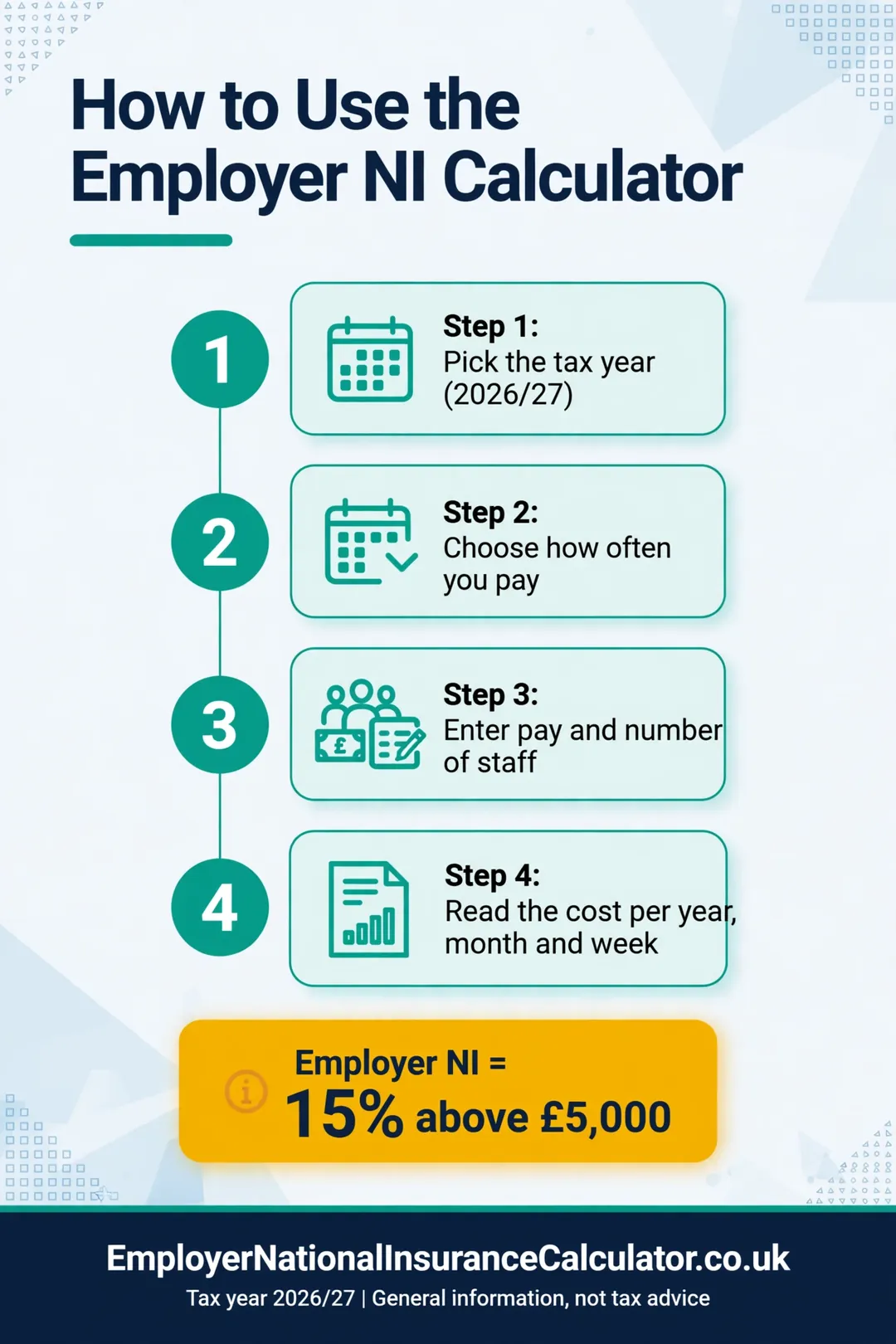
How to use the calculator
- Pick the tax year. 2026/27 is selected for you.
- Choose how often you pay: yearly, monthly, four-weekly or weekly.
- In “Your staff”, enter the pay for one pay period and the number of people on that pay. Pick the type of employee.
- Press “Add another pay level” for each different salary or employee type.
- Open “More options” for a bonus, pension sacrifice, benefits, Employment Allowance or the levy.
The result updates as you type. Four tabs show the summary, a full breakdown, the working step by step, and a comparison of the three tax years. On a phone, the main figure stays at the bottom of the screen while you scroll.
Employer NI at a glance for 2026/27
| Item | 2026/27 figure |
|---|---|
| Employer rate | 15% |
| Secondary Threshold (where employer NI starts) | £5,000 a year, £417 a month, £96 a week |
| Upper Secondary Threshold (under 21, apprentices under 25, veterans) | £50,270 a year |
| Freeport and Investment Zone threshold | £25,000 a year |
| Employment Allowance | £10,500 |
| Class 1A rate (benefits in kind) | 15% |
The government has frozen the £5,000 threshold until April 2031. Every figure is explained in the employer NI rates guide, and the weekly and monthly versions are on the thresholds page.
Worked examples
All three examples use one standard employee, 15% above £5,000, and no Employment Allowance.
| Salary | Taxable pay | Employer NI per year | Per month | Total cost |
|---|---|---|---|---|
| £25,000 | £20,000 | £3,000 | £250 | £28,000 |
| £40,000 | £35,000 | £5,250 | £437.50 | £45,250 |
| £60,000 | £55,000 | £8,250 | £687.50 | £68,250 |
Many businesses pay much less than this. If you can claim Employment Allowance, the first £10,500 of your yearly bill is wiped out. Our guide to Employment Allowance explains who qualifies. More salary levels are on the employer NI by salary page.
What four real businesses pay
Numbers are easier to trust when you see them on a real payroll. Each business below claims Employment Allowance, and each employee is a standard employee over 21.
| Business | Staff and pay | NI before allowance | NI to pay |
|---|---|---|---|
| Café | 2 on £24,000 and 4 on £16,500 | £12,600 | £2,100 |
| Design agency | 8 on £42,000 | £44,400 | £33,900 |
| Care home | 25 on £24,000 | £71,250 | £60,750 |
| One-person company | Director on £12,570, no staff | £1,135.50 | £1,135.50 |
The last row has no allowance. A company whose only paid employee is the director cannot claim it. See the eligibility rules.
A café with small part-time wages pays little because the first £5,000 of every employee’s pay is free of employer NI. The care home is the opposite: many staff on modest pay still add up to a large bill, and the allowance covers a small slice of it.
What the result includes
The main figure is the employer’s Class 1 secondary contribution. That is the NI you pay on top of wages. It is separate from the NI taken out of the employee’s pay.
The calculator can add these extras when you switch them on:
- A bonus, paid once a year to each employee
- Pension salary sacrifice, which lowers the pay that is charged
- An employer pension contribution on top of pay
- Taxable benefits, with Class 1A NI at 15%
- Other costs per employee, such as equipment and training
- The apprenticeship levy, if your pay bill is over £3 million
It does not take the employee’s NI off their wages, because that is the employee’s cost, not yours. For one hire in depth, use the cost of employing someone calculator.
Which employee type to choose
Most people are “Standard”. The other types reduce your bill, so choose them only when the employee truly qualifies.
| Type | When it applies | Employer NI is 0% up to |
|---|---|---|
| Standard | Aged 21 or over, not in another group | £5,000 |
| Under 21 | Employee is under 21 | £50,270 |
| Apprentice under 25 | On an approved apprenticeship | £50,270 |
| Veteran | First 12 months of their first civilian job | £50,270 |
| Freeport or Investment Zone | Eligible new hire working on a special tax site | £25,000 |
Picking the wrong type is the most common reason payroll figures differ from the calculator. The NI category letters guide shows how each type maps to a letter on payroll.
Ways to bring the number down
- Claim Employment Allowance. Up to £10,500 comes off the yearly bill if you qualify.
- Use the reliefs. Under 21s, apprentices under 25 and veterans cost no employer NI up to £50,270. See the exemptions guide.
- Offer pension salary sacrifice. Pay given up for a pension is not charged employer NI today, up to the cap that starts in April 2029. See salary sacrifice savings.
- Pay bonuses into pensions. An employer pension contribution carries no NI at all.
- Check your category letters. A wrong letter can cost you thousands. The calculator’s tips panel shows the savings on your own numbers.
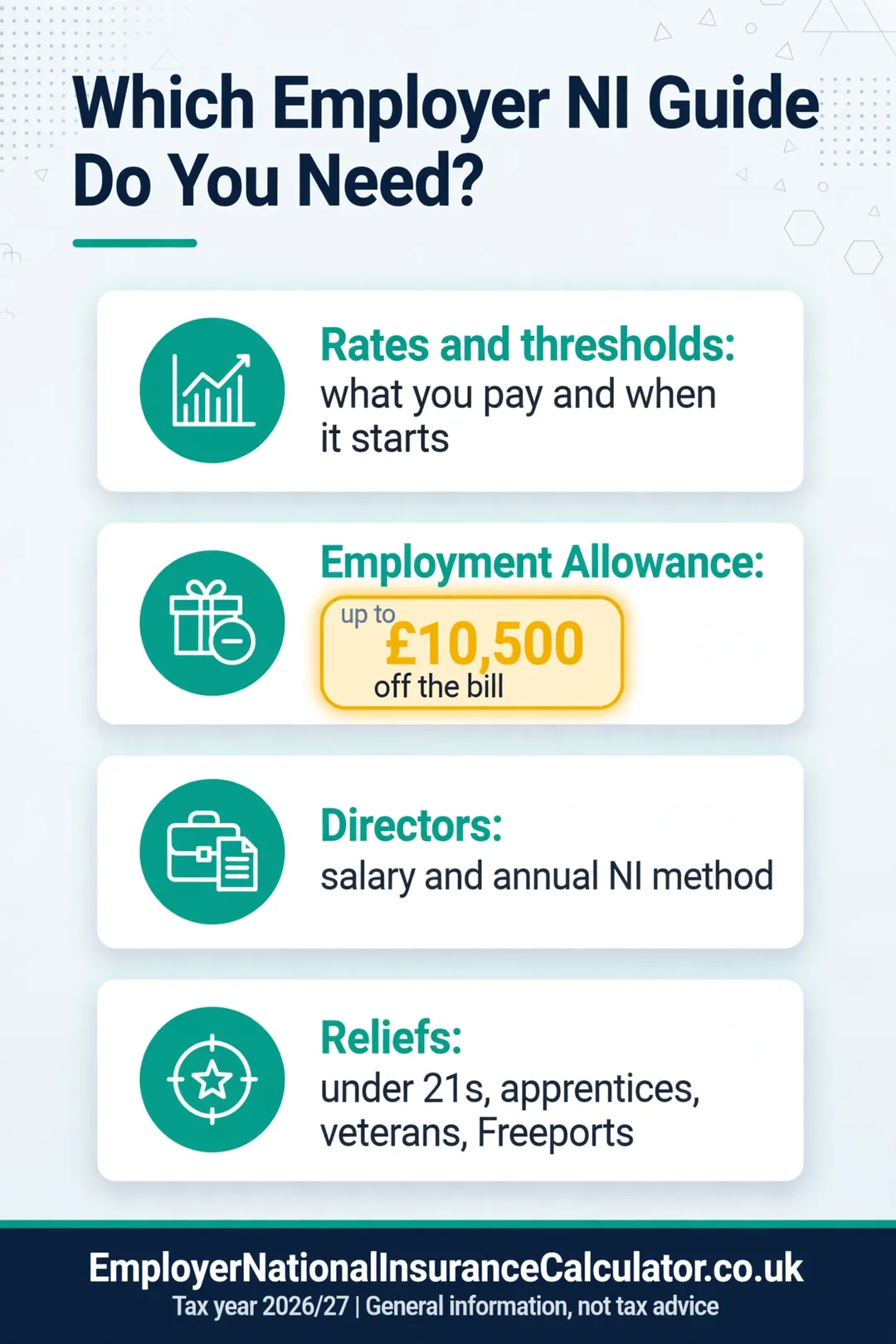
Which guide do you need?
- How the sum works: how employer NI is calculated
- Company directors: director NI calculator
- Cutting your bill: salary sacrifice savings
- Staff who cost less: employer NI exemptions
- Paying a bonus: employer NI on bonuses
- Paying HMRC on time: how to pay employer NI
Who this calculator is for
- Employers with staff on payroll. Check the monthly cost of a person, or of a whole team.
- Business owners planning a hire. See what a salary really costs before you make an offer.
- Directors and accountants. Use the director NI calculator for annual-method sums.
- Payroll teams. Compare your software’s output against a second source.
- Finance managers. Budget a pay rise or a new team using the year comparison tab.
How accurate is it?
The calculator uses the published 2026/27 rates and the same method as HMRC payroll software. Monthly, four-weekly and weekly figures use the rounded pay-period thresholds of £417, £385 and £96.
Three limits are worth knowing:
- It treats pay as the same every period. Real payroll changes with overtime, starters and leavers.
- It treats a bonus as paid in one pay period, as a real payroll run would.
- It cannot know an employee’s category letter, or whether you can claim Employment Allowance. Those answers come from you.
A difference of a few pence against your payroll software is normal, because each system rounds in a slightly different place. A difference of pounds usually points to a wrong category letter or a bonus.
Mistakes to avoid when you use any NI calculator
- Entering the annual salary but picking monthly pay. Check the frequency setting.
- Forgetting the number of staff on the same pay.
- Choosing “Standard” for an under-21 or an apprentice. This overstates the cost.
- Ticking Employment Allowance when you cannot claim it, such as a sole-director company.
- Treating the result as the final payroll figure. Your payroll software and HMRC are the final word.
Is this tool official?
No. This site is independent and has no link with HMRC or GOV.UK. The maths follows the published 2026/27 rates, rates were checked on 20 October 2026, and the sources are listed at the end of this page.
Frequently asked questions
How much employer National Insurance do I pay?
You pay 15% of each employee’s pay above £5,000 a year. For a £30,000 salary that is £3,750 a year, or £312.50 a month. Some employees attract a lower rate, and Employment Allowance can remove up to £10,500 from the total.
Is employer National Insurance 15%?
Yes. The employer rate has been 15% since April 2025 and it stays at 15% for 2026/27. Before April 2025 it was 13.8%, and the threshold was £9,100 instead of £5,000.
Can I claim back employer’s National Insurance?
You can cut the bill with Employment Allowance, and you can correct overpayments through payroll. Reliefs for under-21s, apprentices and veterans work through the employee’s NI category. See our guide to claiming back employer NI.
Is there an upper limit on employer NI?
No. Employee NI drops to 2% above £50,270, but employer NI stays at 15% on every pound above the threshold, however high the salary.
Does employer NI apply to bonuses?
Yes. A bonus counts as earnings, so 15% is added on top. A £10,000 bonus costs £1,500 in employer NI. See employer NI on bonuses.
Is this the same across England, Scotland, Wales and Northern Ireland?
Yes. Employer NI is set by the UK government, so the rates and thresholds are the same everywhere in the UK.
Is the calculator free to use?
Yes. It is free, has no sign-up and no adverts. You can also print the result, copy a link to it, or embed the calculator on your own website.
Does it work for 2025/26 as well?
Yes. Change the tax year at the top. Last year’s rates match this year’s, apart from the Lower Earnings Limit. See the 2025/26 calculator page.
Can I use it for several employees at once?
Yes. Add a pay level for each group, with the number of staff on that pay. The result adds them all together and shows each group in the breakdown.
Why does my payroll software show a different figure?
It may use a monthly threshold of £417 and round each month. A difference of a few pence a month is normal. A larger gap usually means a wrong category letter, a bonus, or an Employment Allowance setting.
Can I save or share my result?
Yes. Use “Copy link” to share the exact figures you entered, “Copy result” for a one-line summary, or “Print” for a paper copy.
Does the calculator work for directors?
It works, but directors are paid on an annual earnings period. For the exact method and the State Pension year check, use the director NI calculator.
Related guides
- Employer NI Rates 2026/27: All Rates and Thresholds
- How Employer National Insurance Is Calculated
- Employment Allowance 2026/27: £10,500 Off Employer NI
- Director National Insurance Calculator 2026/27
- Employer NI by Salary 2026/27: Table and Calculator
Official sources
- National Insurance rates and categories
- Claim Employment Allowance
- HMRC: Rates and thresholds for employers 2026 to 2027
This page is independent information, not tax advice, and has no link with HMRC. Figures were checked on 20 October 2026 for the 2026/27 tax year. Always confirm the final figures with HMRC or your payroll provider.